
Does your pricing cover your overhead and the profit you want?
Bring four core numbers from the last 12 months. In 15 minutes, see the gap between your current profit and your target, and what it could take to close it.
- Free
- 15 min
- Google Meet
Thanks. Now pick a time.
Choose a 15-minute slot below. Your name and number are already filled in.
Loading times…
Have these handy for the call:
- Sales
- Job costs: labor, materials and subs on jobs
- Overhead: business expenses other than job costs and what you pay yourself
- What you pay yourself: salary plus draws
Or just bring your P&L from the last 12 months.
Also handy: Yearly loan and equipment payments, and the profit target you want.
What you leave with
$275K a year gap
About 5.5% more on price for the same work, if costs stay about the same.
Example result- The gap, in dollars, between your current profit and your target
- The margin to bid at, and the floor not to go below
- A one-page result, yours to keep
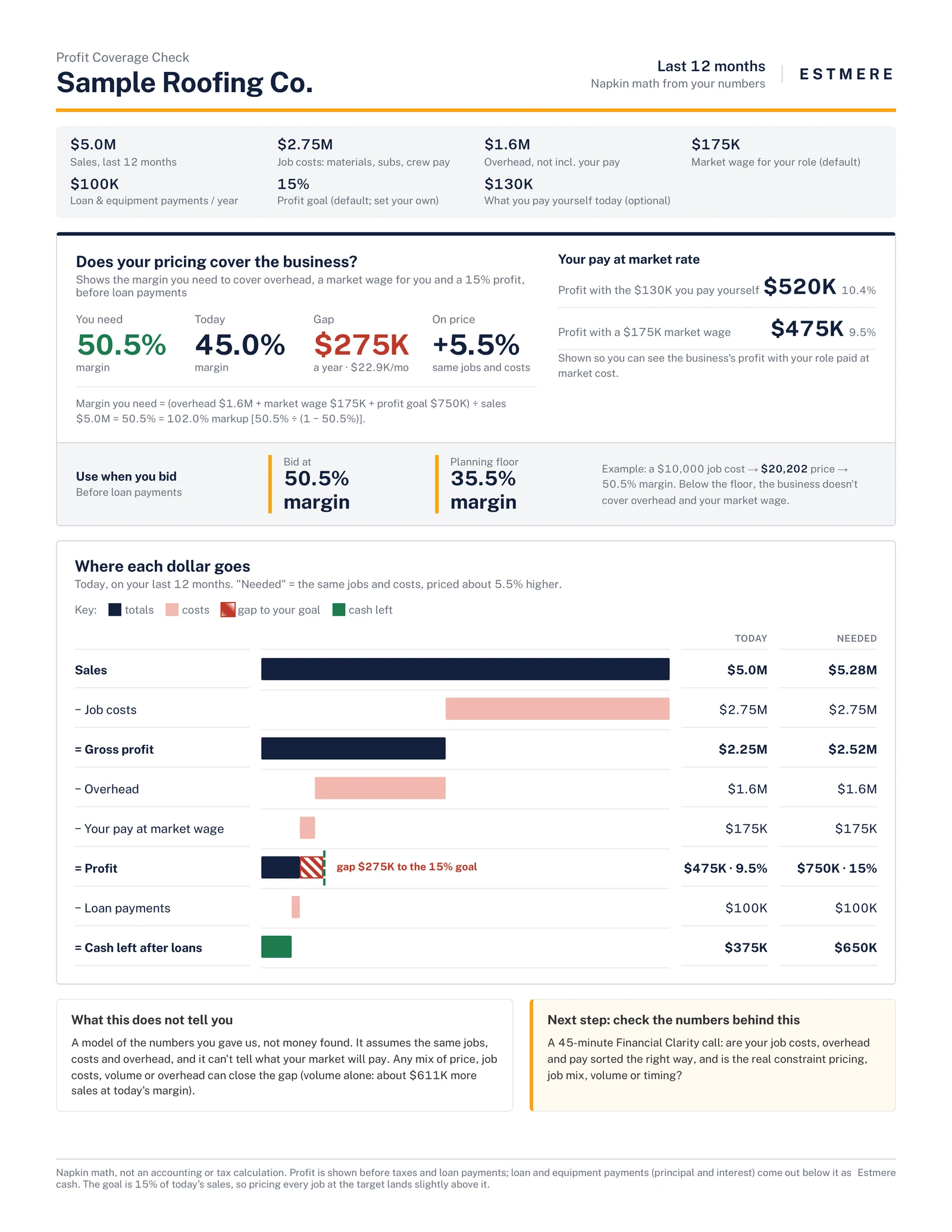 View the full example →
The math behind the example
The example result above uses a made-up company, the same one in the full sample. It does $5,000,000 a year in sales. Job costs (materials, subs and crew pay) are $2,750,000, so it keeps $2,250,000 after jobs: a 45% margin. Overhead is $1,600,000, a market wage for the owner is $175,000, and the owner wants a 15% profit, which is $750,000.
| What the jobs have to cover | Per year |
|---|---|
| Overhead | $1,600,000 |
| A market wage for the owner | $175,000 |
| The profit the owner wants (15% of sales) | $750,000 |
| Total the jobs must earn after job costs | $2,525,000 |
| Earned today after job costs | $2,250,000 |
| Gap | $275,000 |
$2,525,000 is 50.5% of sales, against the 45% the company keeps today. Closing the $275,000 gap takes about 5.5% more on price for the same work, if costs stay about the same. That's modeled, not money found: it shows what prices would have to do, using the numbers given.
Margin and markup are not the same number
Margin is profit as a share of the price. Markup is profit as a share of the cost. The same bid can be described either way, which is why a bid that "adds 50%" often comes up short.
- A 50% markup is only a 33.3% margin.
- The 50.5% margin this company needs is a 102% markup: a $10,000 job cost becomes a $20,202 price.
- Margin to markup: margin ÷ (1 − margin). Markup to margin: markup ÷ (1 + markup).
Four core numbers from the last 12 months
- Sales
- Job costs: labor, materials and subs on jobs
- Overhead: business expenses other than job costs and what you pay yourself
- What you pay yourself: salary plus draws
Ballpark is fine. If your pay is already included in overhead, that's fine. We'll split it out together. Or just bring your P&L from the last 12 months.
Also handy: Yearly loan and equipment payments, and the profit target you want.
How it works
- Step 1
Request your check
Leave your name and mobile, then pick a 15-minute time.
- Step 2
Grab four core numbers
Sales, job costs, overhead and what you pay yourself. Ballpark is fine.
- Step 3
Get your answer
On a 15-minute Google Meet, we run the math together. You keep the one-page result.
RJ and the Estmere Team have been absolutely game changer for our business. RJ is our CFO and we couldn't do what we do without him. If there was 10 stars I would leave that, highly recommend!
Estmere is an accounting and advisory firm for contractors and home-service owners. We help owners get clear on their numbers so they can price with confidence and grow their profit.
Questions
What does it cost?
The check is free. Ongoing work depends on scope, so we don't quote it on the call.
Is this a sales pitch?
It's a working session, not a proposal call. You leave with the math and the one-page result. If you want help after that, we can talk about it separately.
I already have a CPA or bookkeeper.
Keep them. This is about whether your pricing covers your overhead and your profit target.
I don't know my numbers exactly.
Ballpark is fine, from memory. Nothing to upload or send ahead.
What's the difference between margin and markup?
Margin is profit as a share of the price; markup is profit as a share of the cost. A 33.3% margin is a 50% markup, and a 50.5% margin is a 102% markup.
Who is it for?
Owner-led contractors and home service businesses: general contractors, remodelers, specialty trades, HVAC, plumbing, electrical and roofing.